Program: Managing Nutrients in the Western Lake Erie Basin
Program details » | All Managing Nutrients in the Western Lake Erie Basin projects »
GLRI Funding Opportunities for Expanding Nutrient Management Technical Assistance in the Western Lake Erie Basin (WLEB)
Background
Harmful algal blooms (HABs) occur when excess nutrients are discharged into natural waters. These nutrients, primarily nitrogen and phosphorus, are transported by tributaries to larger bodies of water as runoff and fuel the growth of algae, which can be extremely harmful to aquatic life and water quality.
Read more background information
While environmental factors such as warm water temperatures and slow-moving water can worsen the problem, human activity—especially agricultural runoff from fertilizer and animal waste—is the primary cause in the Western Lake Erie Basin (WLEB), where 80% of the watershed is agricultural land. To reduce HABs, the amount of nutrients entering these bodies of water must be reduced. Past efforts to reduce nonpoint source nutrients have had limited success, warranting broader approaches to minimize runoff while maintaining crop yields.
Best management practices (BMPs) are farming techniques that can reduce this nutrient runoff and therefore improve water quality in watersheds that are heavily impacted by agriculture. Within the agricultural community, new BMP incentives have increased demand for nutrient management services, leading to initiatives such as the WLEB Conservation District's Soil Health Investment Program (SHIP).
Examples of BMPs include:
- Reduced tillage
- Cover crops
- Precision nutrient management
- Filter or buffer strips
- Perennial forages
- Controlled drainage systems
- Prairie strips
- Water and sediment control basins
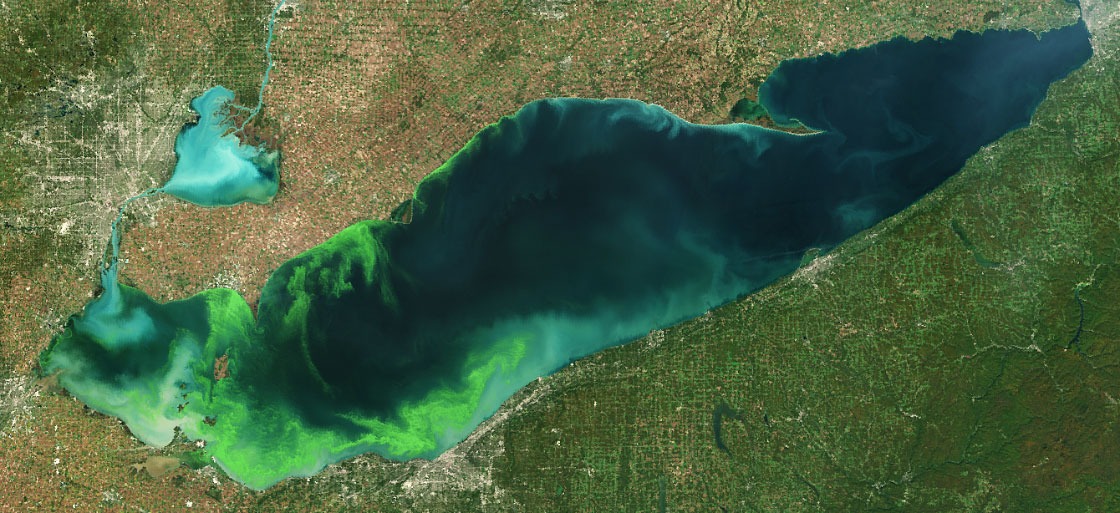
Harmful algal blooms in the western basin of Lake Erie appear on a European Space Agency (ESA) Envisat satellite. Image taken on Oct. 8, 2011, using its MERIS sensor. Credits: ESA.
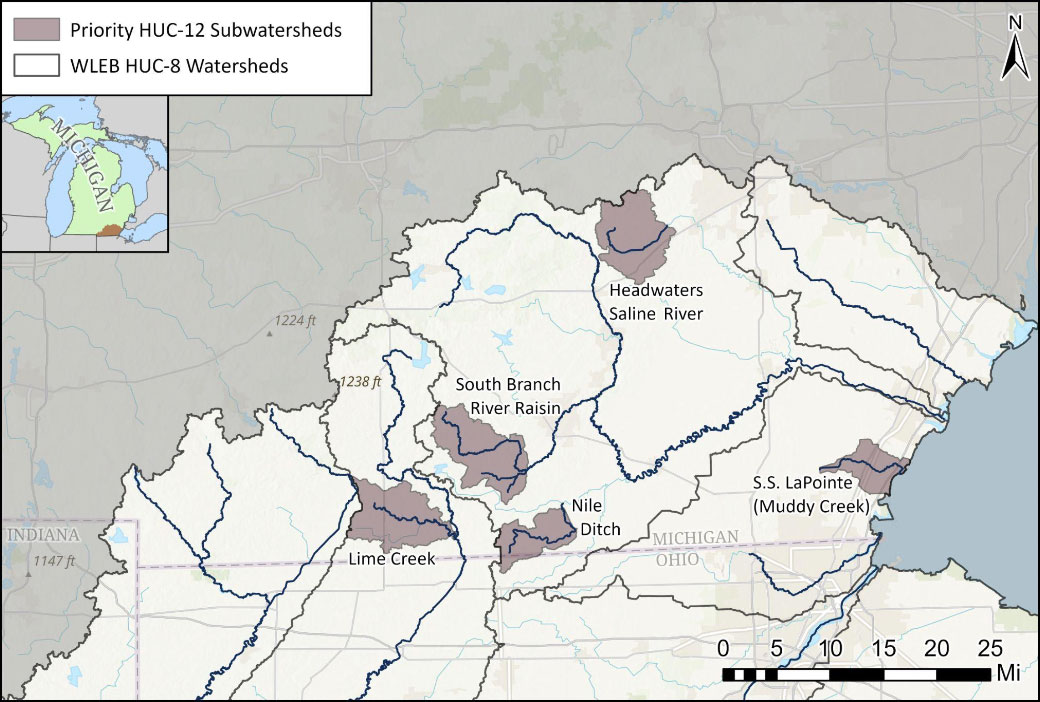
Map of the WLEB HUC-8 watersheds. Darker color indicates priority HUC-12 Subwatersheds. Credits: MDARD.
Expanding Nutrient-Management Technical Assistance
The growing demand among producers for technical assistance to support better nutrient management presents an opportunity to expand service provider capacity and establish a formal system for recording and tracking nutrient management plans (NMPs) and practices.
The Great Lakes Restoration Initiative (GLRI) has funded the University of Michigan Water Center’s TRAIN program to improve overall water quality in Lake Erie by supporting producers, Conservation Districts, and technical assistance providers to achieve precision nutrient management in the WLEB. Building on a growing network of agricultural stakeholders who have been active in the WLEB Community Advisory Group since its formation in August 2023, TRAIN aims to:
- Build capacity among conservation districts and private-sector technical assistance providers to foster enhanced collaboration and communication through regular meetings, shared resources, and coordinated engagement efforts.
- Provide professional development and funding opportunities to incentivize the development and implementation of precision NMPs and BMPs across the Western Lake Erie Basin.
- Create a shared web platform to organize and track conservation work.
- Monitor changes in water quality through targeted efforts in Michigan’s five priority subwatersheds.
To increase the number of technical assistance providers capable of implementing precision NMPs in the WLEB, TRAIN offers two funding opportunities:
- A professional reimbursement program.
- Nutrient management practice-based implementation incentives.
The professional reimbursement program serves as the foundation for building the technical knowledge and skills needed to expand nutrient management services across the WLEB. It helps reduce financial barriers for agricultural professionals pursuing education and certification opportunities that strengthen their ability to deliver nutrient management services. Eligible applicants include:
- Technical service or assistance providers, agronomists, or certified crop advisors (CCA) who serves producers in Michigan’s WLEB;
- Staff members of a Conservation District within the basin (Monroe, Lenawee, Hillsdale, or Washtenaw Counties); or
- Private-sector partners (e.g., cooperatives, custom applicators, agricultural retailers) who work directly with producers to implement nutrient management practices.
Reimbursements may cover registration, lodging, and transportation for approved professional development activities. Approved travel expenses include mileage for personal vehicles, commercial flights, rental cars, public transportation, parking, and lodging directly associated with attendance at an eligible event. Examples of eligible activities include:
- 4R Nutrient Stewardship Certification Program
- Michigan Manure Hauler Certification Program
- MSU Extension Field Demonstration Events
Applicants can receive up to $1,500 per individual for approved expenses. Applications are accepted on a rolling basis and reviewed by the Water Center team, with reimbursements typically issued within 3-4 weeks. By participating, technical assistance providers not only gain valuable credentials but also contribute to a basin-wide effort to improve soil health, reduce nutrient runoff, and enhance the resilience of Michigan’s agricultural systems.
To strengthen our collaboration and maintain ongoing communication within the watershed, TRAIN invites all technical assistance providers to join our Technical Assistance Provider (TAP) Directory.
Our Technical Assistance Provider Directory is a growing network of agricultural professionals working across Michigan’s WLEB to advance precision nutrient management and improve regional water quality. By joining the directory, you’ll be connected to a community of Conservation District staff, agronomists, crop advisors, and other private-sector providers who share a commitment to supporting producers and promoting sustainable farming practices.
The TAP Directory serves to:
- Acts as a contact list for future TRAIN newsletters and program updates.
- Connect professionals across the WLEB to share technical resources, event opportunities, and lessons learned.
- Helps project partners better understand who is delivering nutrient management services and where support is most needed.
- Strengthens collaboration among those working to reduce nutrient loss, improve soil health, and build the technical capacity of the region.
Joining the TAP Directory ensures that you stay informed, connected, and part of a growing community working together toward cleaner water and more resilient agriculture in Michigan.
Sign up to join our TAP Directory
The TRAIN Program compensates technical assistance providers and other eligible participants for developing and implementing nutrient management plans that use variable rate technology (VRT) on participating farms.
Funding is available for fields located within the geographic boundaries shown on the maps below:
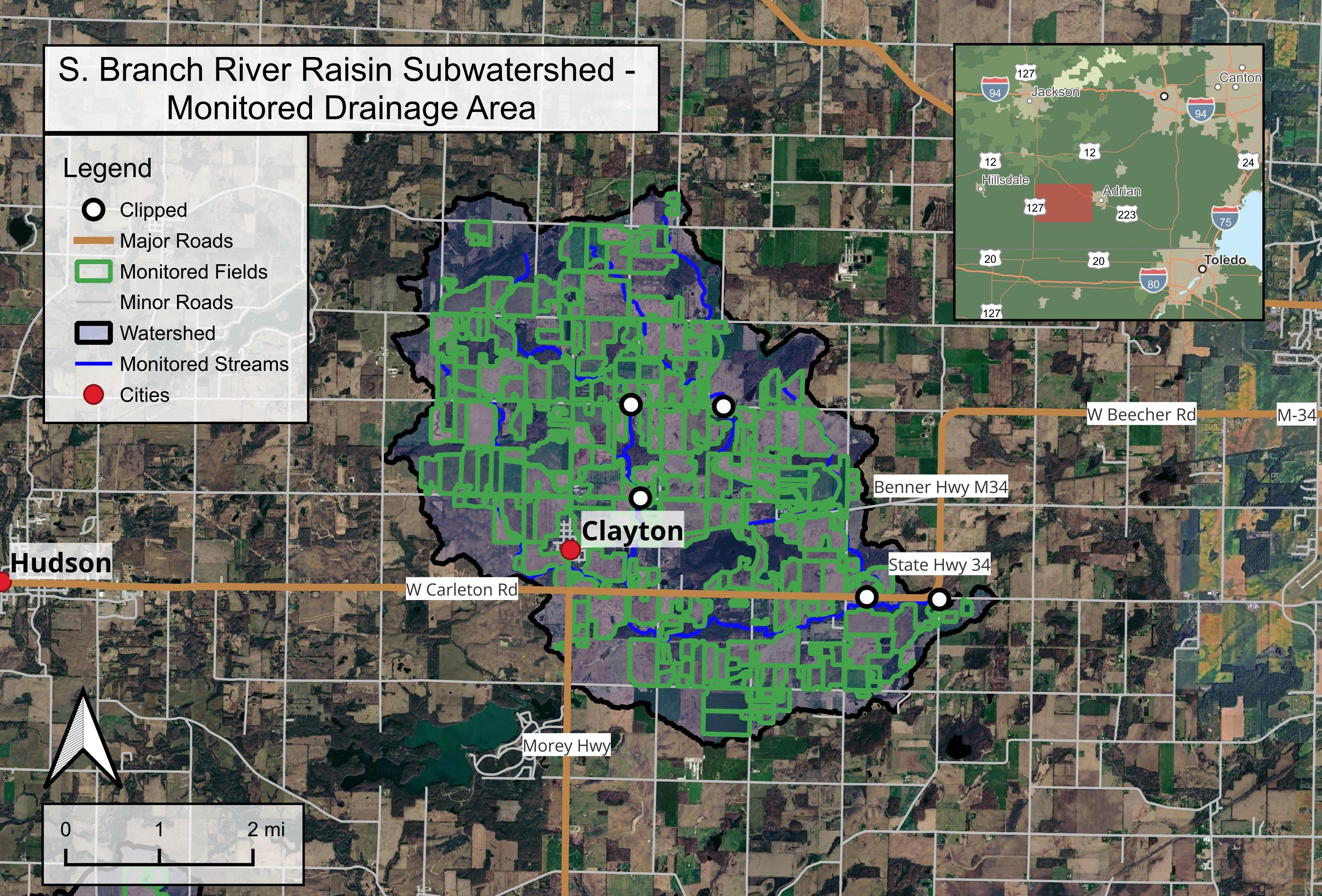
Map of the Monitored Drainage Area within South River Raisin Subwatershed. Data provided by Limotech monitoring stations. Map Credits: George Edison, Jul. 2026.
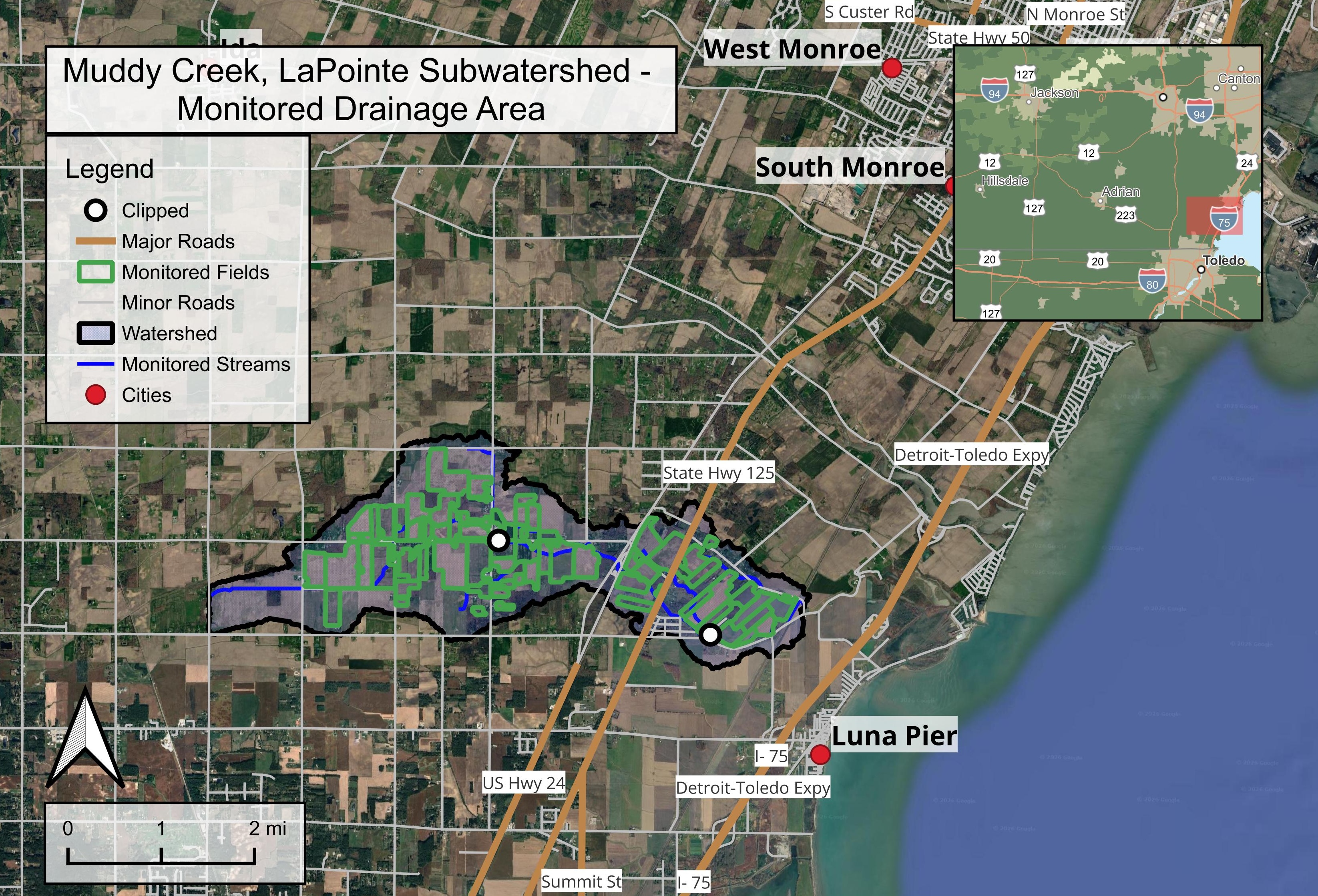
Map of the Monitored Drainage Area within Muddy Creek/SS LaPointe Subwatershed. Data provided by Limotech monitoring stations. Map Credits: George Edison, Jul. 2026.
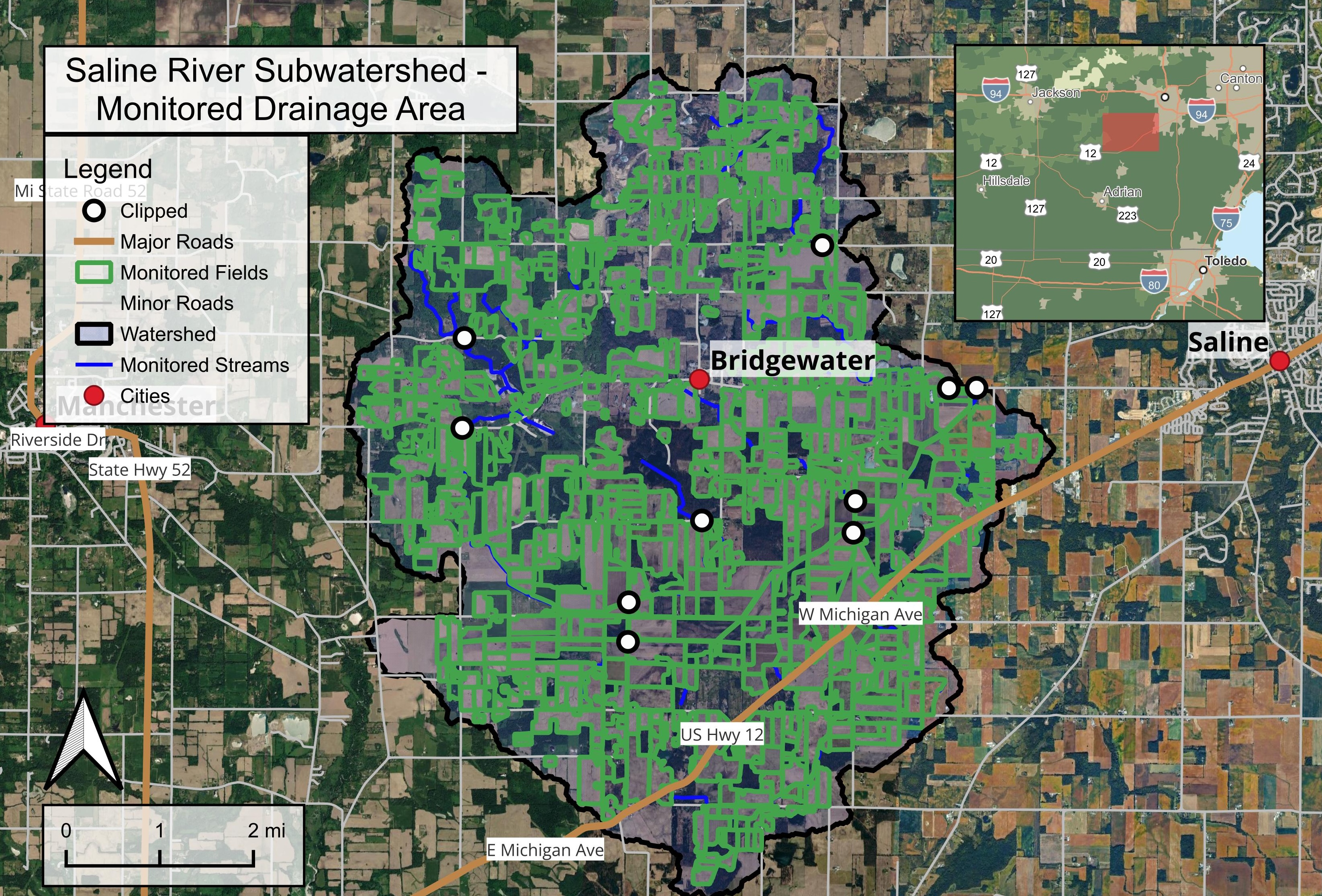
Map of the Monitored Drainage Area within Saline River Subwatershed. Data provided by Limotech monitoring stations. Map Credits: George Edison, Jul. 2026.
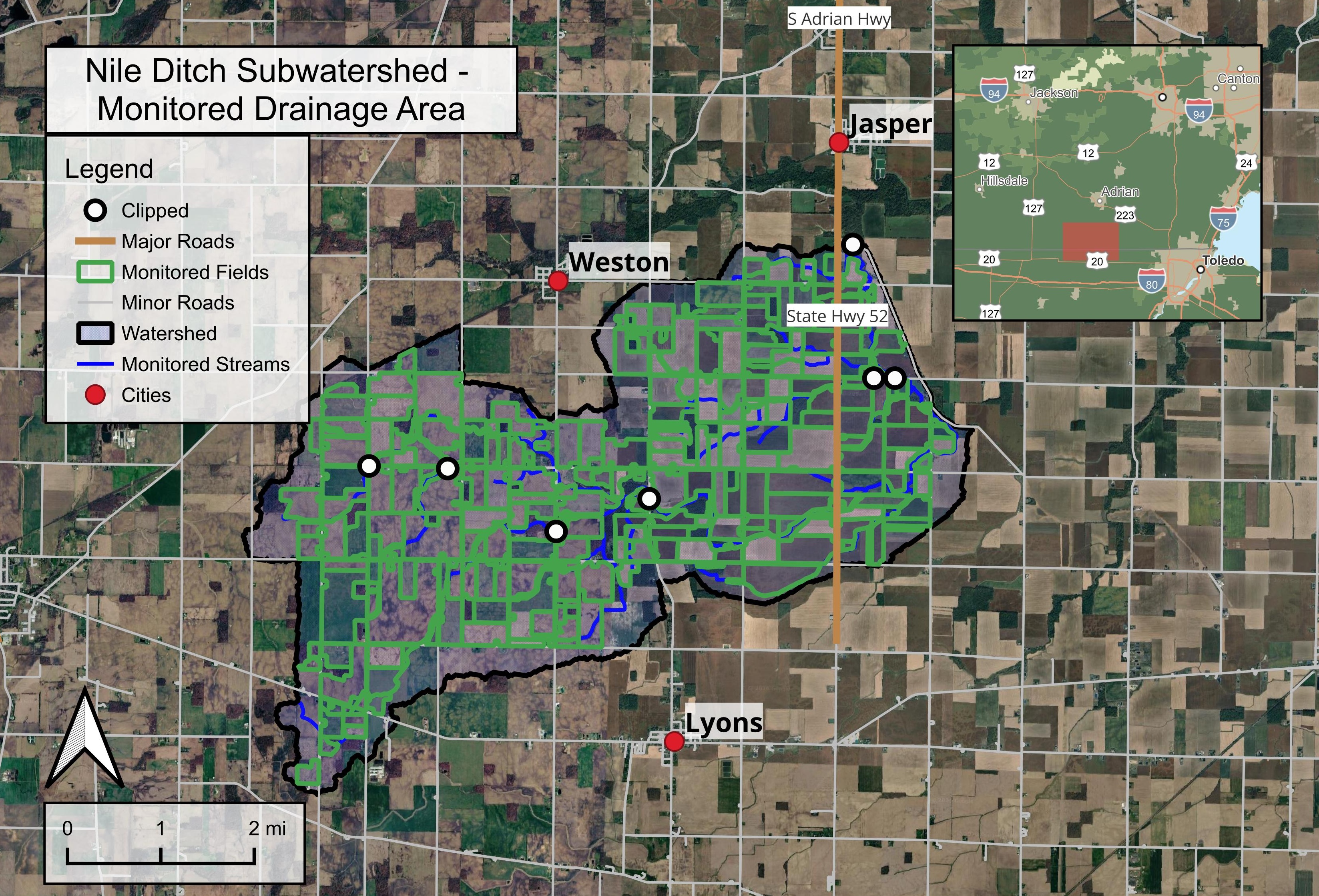
Map of the Monitored Drainage Area within Nile Ditch Subwatershed. Data provided by Limotech monitoring stations. Map Credits: George Edison, Jul. 2026.
Map of the Monitored Drainage Area within Lime Creek Subwatershed. Data provided by Limotech monitoring stations. Map Credits: George Edison, Jul. 2026.
Who is Eligible?
Technical assistance providers (TAPs), agricultural retailers, producers, and custom applicators may receive payment for completing eligible activities:
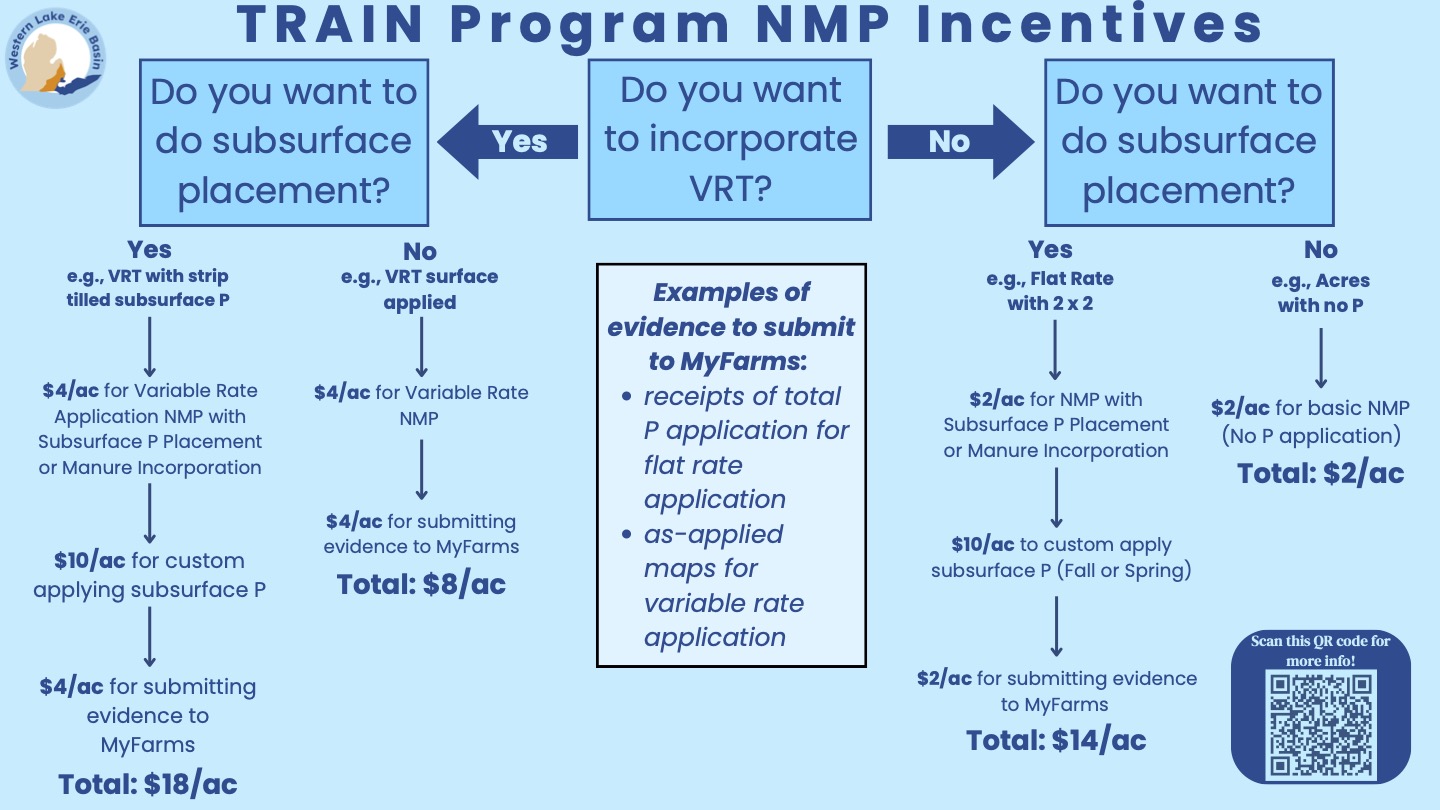
- Nutrient management planning: The person or organization that writes a nutrient management plan (NMP) and uploads it to the MyFarms platform will receive the planning payment.
- Practice implementation: The person or organization that applies subsurface phosphorus (P) and/or uses VRT for fertilizer placement, and uploads documentation of the completed practice to MyFarms, will receive the implementation payment.
Soil Sampling Support
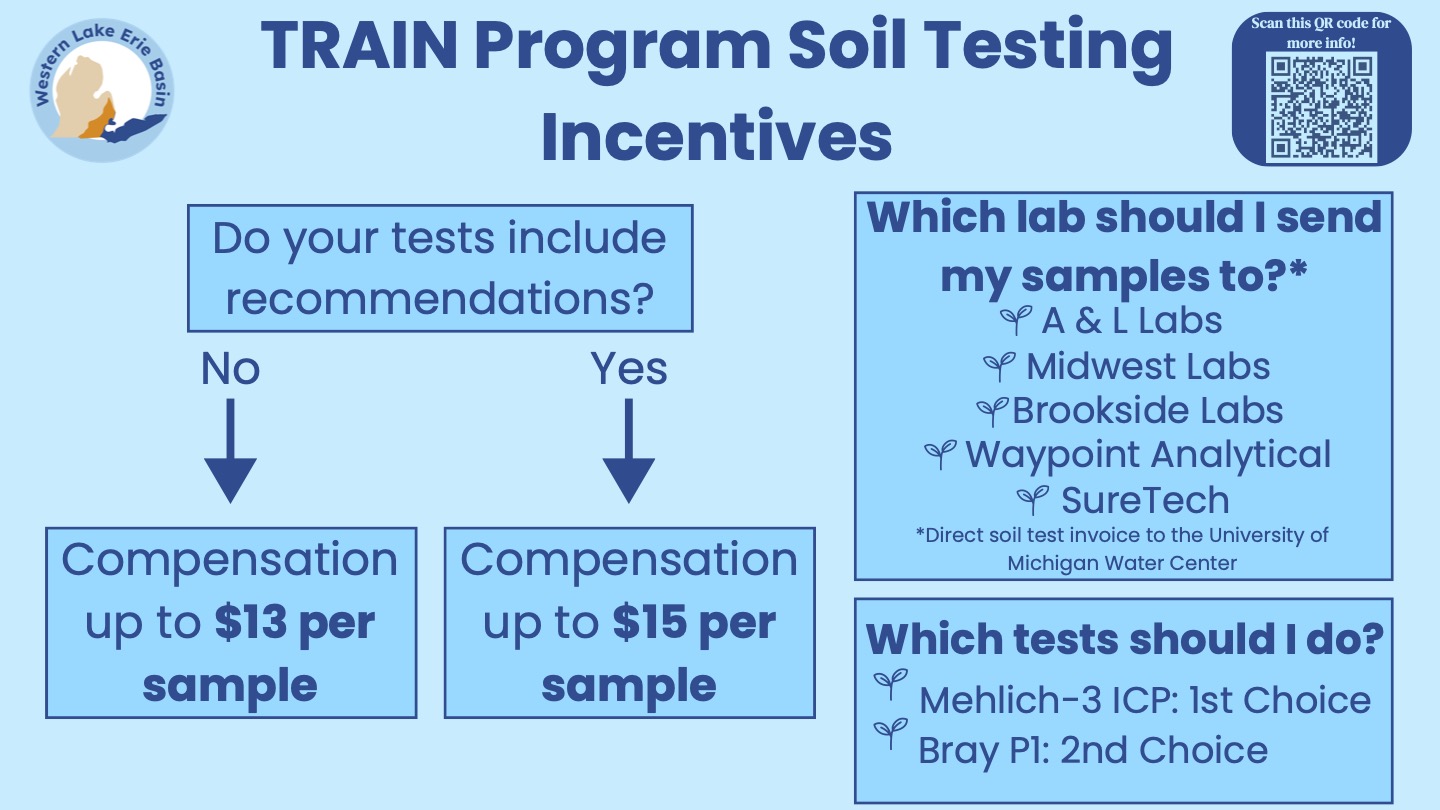
TRAIN will also fund new, georeferenced grid or zone soil sampling at a density of fewer than 12 acres per sample when:
- Existing soil samples are more than three years old; or
- VRT will be used and the existing samples represent more than 12 acres per sample.
The graphics below explain the payment structure for these activities. Scan the QR code in the corners to be taken to a more detailed description of the overall program structure.
Interested in participating?
Please sign up through the TAP Directory. After you register, we will email you to schedule a meeting and review the program’s GIS maps.
More Information
Apply for reimbursement: Professional Development Reimbursement Program
Contact Management System
We’re currently partnering with the Lenawee, Monroe, Hillsdale, and Washtenaw Conservation Districts to implement a contact management system for the WLEB. We’re piloting Little Green Light as the platform.
Annual Advisory Board Meeting
We have held three board meetings thus far which were held on October 9th 2025, February 23rd, 2026, and June 23, 2026. Our next advisory board meeting will be fall 2026.
Reimbursement Program
Our professional development reimbursement program is now fully launched. Our website includes a non-exhaustive list of professional development opportunities that are pre-approved for reimbursement, along with a reimbursement request form.
NMP Implementation Program
We are currently finalizing the payment structure for the Nutrient Management Plan Implementation portion of our grant. In the coming year, we plan to offer funding to support soil sampling and for development of both basic nutrient management plans and plans using variable rate technology (VRT) and subsurface fertilizer placement. We are working with MyFarms to expand technology used by H2Ohio to Michigan to track and verify nutrient management plans.
Hosted Meetings
In December 2025, we held a series of meetings co-hosted with Chris Fennig to assess the functionality of MyFarms within the WLEB. We held separate meetings for farmers, technical assistance providers/conservation district staff, and government agencies and have since used what we learned from those meetings to develop a funding proposal to bring MyFarms to Michigan.
In February 2026, we hosted a meeting with conservation district staff to discuss the needs of a CRM platform, in which we decided to move forward with demoing Little Green Light.
In Summer 2026, we are meeting with ag retailers and other techncial assistance providers to recruit participants to the upcoming NMP implementation program.
Advisory Board
An advisory board comprised of 10 stakeholders within the WLEB, representing the private sector, producer community, producer associations, Conservation Districts, Extension, and state agencies, will guide the administration of the project, ensuring it is on track and meeting community standards and needs.
| Sector | Organization | Name |
|---|---|---|
| Private TSP - independent | Sustainable Ag Solutions | Adam Shedd |
| Private TSP - independent, does not sell fertilizers | Nester Ag | Clint Nester |
| Private TSP - big company | Nutrien | Caleb Fox |
| CD TSP | Lenawee CD | Airin Beechler and Allegra Baird |
| Producer | Bakerlads | Blaine Baker |
| Extension | Michigan State University | Sarah Zeiler and Korede Olugbenle |
| Producer Association | Corn Marketing Program of Michigan | Kristin Poley |
| Producer Association | Michigan Farm Bureau | Tess Van Gorder |
| State Rep | MDARD | Michelle Selzer |
| State Rep | EGLE | Brittany Santure |
Hosted Webinar
Quality Assurance Project Plan (QAPP)
Per EPA regulations, our Quality Assurance Project Plan specify the methods of collection, analysis, and use of environmental data to certify that the TRAIN program complies with State standards.
- Alison Bressler - Project Manager, U-M Water Center ([email protected])
- Olivia Byrd - Program Assistant, U-M Water Center ([email protected])
- Grace Baily - Photographer, U-M Water Center ([email protected])
- George Edison - GIS Analyst, U-M Water Center ([email protected])
- Zoe Frankel - Data Analyst, U-M Water Center ([email protected])
A: Eligibility for our professional development reimbursement program is open to organizations and individuals providing agricultural technical support or services within the Michigan portion of the WLEB. Possible services include:
- Phosphorus management plan development
- Nutrient management planning
- Soil sampling and analysis
- Conservation practice recommendations
- Precision agriculture support
Visit our reimbursement program overview for full details on eligibility criteria.
Eligibility for our nutrient management practice-based implementation incentives extends to any technical assistance provider who supports the implementation of precision NMPs in the five five priority HUC-12 subwatersheds in the WLEB.
A: Possible trainings and workshops, as deemed by the Advisory Board, include but are not limited to:
- Michigan Manure Hauler Certification Program
- Variable Rate Technology Training
- Certified Crop Advisor exams
- Michigan State University Extension field demonstration events & workshops
- Nutrient management education workshops
- Trainings covering topics in NRCS’s Conservation Planning Process
- Nutrient management conferences such as Tech Hub Live, Conservation Tillage and Technology Conference, and Brookside Labs Annual Amplify Conference
- Software training
- Continuing Education Units related to nutrient management
See our reimbursement program page for all approved trainings and conferences. Approved professional development opportunities are updated by the TRAIN team regularly.
A: Yes, these benefits can be used for your own continuing education or to support training for your staff, expanding your organization’s capacity to deliver nutrient management services.
A: Applications are open at this time and will be accepted on a rolling basis until funding is exhausted or by Summer 2028.
A: Professional development reimbursement funds will be awarded to eligible organizations and individuals up to $1,500 per individual for expenses directly associated with attending an approved training or workshop. Such expenses include:
- Registration or certification fees
- Travel: mileage for personal vehicles at $0.7/mile, commercial flights, rental cars, public transportation, parking
- Lodging
Once you have completed our reimbursement request form, the TRAIN team will review your submission.
Criteria for nutrient management practice-based implementation incentives are currently being developed with our Advisory Board.
A:
- Attend/participate in your chosen training or workshop
- Keep all receipts and documentation of attendance
- Complete the reimbursement request form within 30 days of your event
Professional development reimbursements will be distributed by check within 3-4 of submitting receipts for expenses associated with your chosen approved training or workshop. Businesses submitting reimbursements will first need to create a vendor account through U of M before completing the reimbursement form.
A: Nutrient management practice-based payments will be made per acre that you can demonstrate successful implementation of a new nutrient management practice. This can be as simple as writing and implementing a farm’s first nutrient management plan to as complex as using a new technology to advance precision application methods or apply a fertilizer that has been shown to reduce leaching and runoff potential. Further activities include:
- Precision nutrient management application, including variable rate application and yield monitoring in order to base nutrient recommendations on average yields achieved at the field scale
- Implementation of 4R strategies: right rate, source, placement, and timing of plant nutrients and soil amendments to maintain yield while reducing environmental impacts
- Nutrient drawdown in the soil by reducing phosphorus inputs
- Practices that draw down soil test phosphorus levels and utilize 4R strategies to reduce unnecessary phosphorus application and reduce phosphorus losses
A: The nutrient management web platform is created to be private with a log-in system to access nutrient management plans you are working on with producers. The only people with access to your information would be other technical service providers and producers who you have agreed to collaborate with.
A: Practice-based payments will be made per acre that you can demonstrate successful implementation of a new nutrient management practice. This can be as simple as writing and implementing a farm’s first nutrient management plan to as complex as using a new technology to advance precision application methods or apply a fertilizer that has been shown to reduce leaching and runoff potential. Further activities include:
- Development and implementation of Nutrient Management Plans (NMPs): Writing and carrying out a farm’s NMP or upgrading existing plans to integrate precision practices focused on phosphorus reduction and soil health.
- Precision nutrient management application: Including variable rate technology, GPS/yield monitoring, and soil mapping to base nutrient recommendations on average yields and actual field conditions.
- Implementation of 4R strategies:
- Right rate (based on soil testing and field data to avoid over-application)
- Right source (matching fertilizer type to crop, soil, and environmental conditions)
- Right placement (banded or subsurface—not broadcast—applications to minimize runoff and enhance uptake)
- Right timing (frequent, split applications aligned with crop demand and uptake patterns)
- Phosphorus drawdown management: Practices that demonstrate lower total phosphorus input by reducing application rates, adopting precision technology, and utilizing amendments proven to decrease leaching and runoff risk.
- Use of custom applicator services and new technology: Utilizing professional applicators with advanced equipment (e.g., variable rate spreaders, banded placement machinery) to improve fertilizer efficiency and minimize losses.
- Integration of decision support and information systems: Employing remote sensing, GIS mapping, and weather-based decision tools to more precisely manage timing and placement of nutrients in response to rain or soil moisture.
- Tracking outcomes and improvements using digital tools: Recording new acres and practices in cloud-based platforms to ensure nutrient management impacts are documented and measurable.