Program: Catalyst Leadership Circle Fellowship
Program details » | All Catalyst Leadership Circle Fellowship reports and resources »
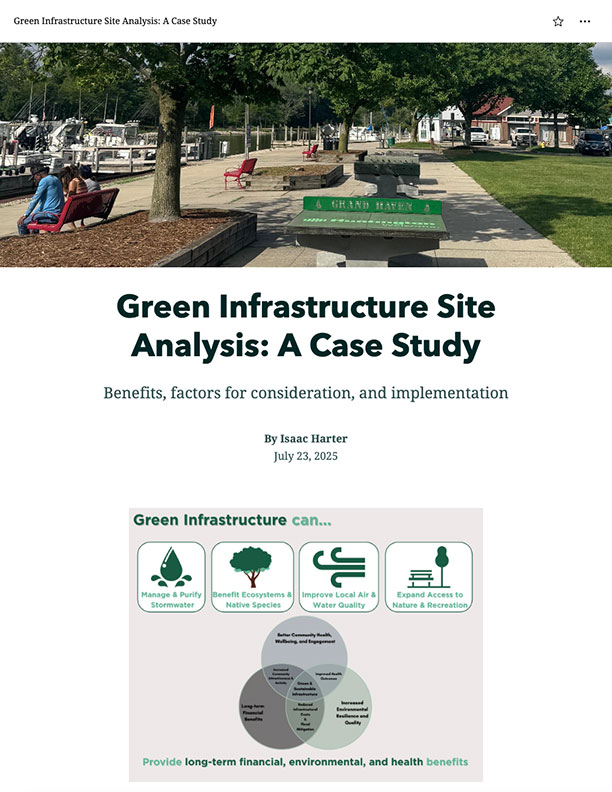
As climate change increases the intensity of flooding events, green infrastructure systems help municipalities manage stormwater runoff by mimicking the natural water cycle. Like many Michigan cities, Grand Haven is working to improve local environmental quality, increase recreational space, and protect the local watershed and other sensitive ecosystems. Green infrastructure works towards these goals by offering a variety of economic, social, and environmental benefits that strengthen local environmental resilience and quality of life.
To help facilitate the development of green infrastructure, CLC Fellow Isaac Harter identified opportunities for green stormwater infrastructure at Grand Haven’s Chinook Pier. His recommendations, such as a bioretention pond and a green roof, support the city’s sustainability goals while enhancing the site’s usability. In addition, Isaac developed a practical site analysis framework, identified relevant resources, and compiled policy recommendations to make public and private development more feasible. While locally focused, this work provides a replicable site analysis toolkit, including important site factors and methods to determine suitable improvements, as well as identification of current policy in Grand Haven that other cities could emulate to promote green infrastructure systems. The companion ArcGIS StoryMap serves as an accessible and interactive tool that explains the site analysis process with the analysis of Chinook Pier as a case study.