Catching the Waves: Empowering Beaver Island with Clean, Local Energy
Catching the Waves: Empowering Beaver Island with Clean, Local Energy
Catching the Waves: Empowering Beaver Island with Clean, Local Energy
Program: Catalyst Grants
Program details » | All Catalyst Grants projects »
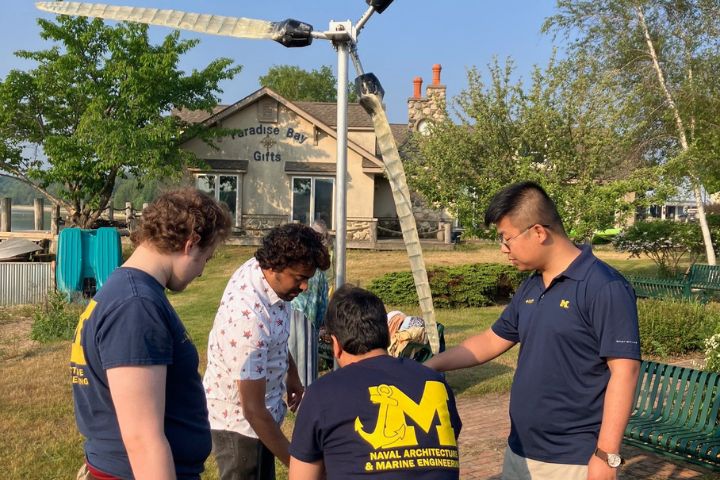
Project team on site | Photo courtesy of Beaver Island Association
With an energy density more than ten times that of wind energy, marine wave energy is a promising solution for sustainable power generation. Although prototypes have been deployed worldwide, demonstration of grid-connected wave energy converters (WECs) is still lacking. To help close this gap, this Catalyst-funded project team identified a potential WEC deployment site on Beaver Island, informed by the local communities’ needs and priorities. They also developed planning tools to explore wave energy as a solution for remote and underserved coastal communities. The team’s progress and preliminary findings helped secure $3.6 million from NSF’s Growing Convergence Research program, along with a $99,992 NSF workshop grant to support continued development and deployment.
Beaver Island, located in Lake Michigan, is home to about 600 permanent residents who currently rely on fragile power connections and diesel generators. In order to meet the needs of residents, the team combined technical analysis with strong community engagement. They assessed wave energy resources using NOAA historical data, carried out site visits, and interviewed more than 30 island residents. The team also participated in the Beaver Island Sustainability Fair and hosted community forums to ensure local priorities shaped project decisions. These efforts informed technology selection and supported the development of Blue Choice, an AI-based decision support tool designed to recommend site-specific wave energy technologies based on both expert analysis and community input.
The project built a foundation for developing WEC systems to power critical infrastructure, including evacuation routes and emergency alert systems, and strengthened relationships between the Beaver Island community and U-M researchers. In addition, the project provided hands-on research and engagement opportunities for both graduate and undergraduate students. Supported by NSF funding, the team plans to deploy and test WEC prototypes on Beaver Island, refine the Blue Choice tool, and conduct long-term monitoring through buoy deployments – building on a strong foundation to advance marine renewable energy solutions in Michigan and beyond.
Media Coverage
- Unlocking ocean power: $3.6M for community-centric wave energy converter, University of Michigan News
- Beaver Island takes early steps to test wave energy in its waters, WCMU Public Radio
- Beaver Island selected as testing grounds for wave energy prototype, FOX 2 Detroit
- Renewable wave energy project to launch on Beaver Island, mlive.com
This Project Received a $10,000 Catalyst Grant in 2024.
Project team: Xiaofan Li, PI (Naval Architecture and Marine Engineering); Ayumi Fujisaki-Manome, Co-PI (Cooperative Institute for Great Lakes Research/Climate & Space Sciences and Engineering); Lei Zuo, Co-PI (Naval Architecture and Marine Engineering); Gail Gruenwald, Additional Team Member (Beaver Island Association); Sun Kyoung Lee, Co-PI (Institute for Social Research).