Empowering Flint Solar: Exploring a Cooperative Model to Increase Energy Sovereignty
Empowering Flint Solar: Exploring a Cooperative Model to Increase Energy Sovereignty
Empowering Flint Solar: Exploring a Cooperative Model to Increase Energy Sovereignty
Program: Catalyst Grants
Program details » | All Catalyst Grants projects »

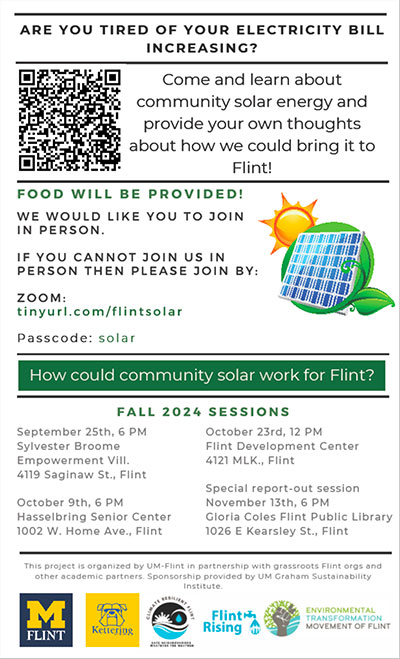 View/Download Flyer (PDF)
Project Summary
Flint residents face one of Michigan’s highest energy burdens, spending a disproportionate amount of their income on energy bills compared to the state average. Community-level renewable energy offers a promising pathway to make energy more affordable for Flint residents while improving environmental health.
Building on long-standing relationships with local grassroots organizations such as the Environmental Transformation Movement of Flint and Flint Rising, PI Heather Dawson led a collaborative initiative to explore community solar opportunities in Flint. Supported by Catalyst Grant funding, Dawson and a team of faculty from UM-Flint and Kettering University coordinated a comprehensive feasibility study to assess key opportunities, constraints, and community preferences for solar energy. What began as a partnership between the research team and community organizations expanded to include city council leaders, technical experts, and faith leaders, and eventually grew into a broader engagement effort with Flint residents.
In collaboration with local faith leaders, the team conducted participatory meetings and workshops in Flint neighborhoods where energy burdens are highest, surfacing residents’ priorities and barriers. In addition to building citizen trust and support for community-based solar power, the events revealed that residents view faith-based and community centers as potential resilience hubs where solar power could improve access to warming, cooling, safety, food, and assistance, especially during power outages. Legislative change emerged as a community priority, key to enabling the development of solar cooperatives on vacant lots to lower energy bills and enhance energy resilience. The team plans to connect faith leaders with other nonprofit leaders to support community-driven solar development and establish demonstration solar sites on houses of worship or community centers in the future.
The project fostered partnerships between local organizations, community leaders, Flint residents, and technical experts, laying the groundwork for continued progress toward community solar in Flint. A new collaboration between project team members and Flint’s Sylvester Broome Empowerment Village (SBEV), has led to spin-off initiatives that have strengthened SBEV’s capacity to serve the local community. The project team also intends to raise awareness about pending state Senate and House bills aimed at loosening restrictions on community solar in Michigan. The insights from this project informed Flint’s updated sustainability plan and the integration of sustainability initiatives into the city’s Master Plan as part of a bigger project supported by a $1 million EPA grant.
This project received a $13,000 Catalyst Grant in 2023.
Project team: Heather Dawson, PI (Biology | UM-Flint); Mihai Burzo, Co-I (Engineering | UM-Flint); Pamela Carralero, Co-I (Environmental Humanities | Kettering University); Shirl Donaldson, Co-I (Digital Manufacturing Technology | UM-Flint); Karl Hoesch (SEAS | U-M Ann Arbor); Mona Munroe-Younis, Co-I (Environmental Transformation Movement of Flint); Stephen Turner, Co-I (Computer Science | UM-Flint); Nayyirah Shariff (Flint Rising).