Alley Activation as a Practical Neighborhood Sustainability Strategy
Alley Activation as a Practical Neighborhood Sustainability Strategy
Alley Activation as a Practical Neighborhood Sustainability Strategy
Program: Catalyst Grants
Program details » | All Catalyst Grants projects »
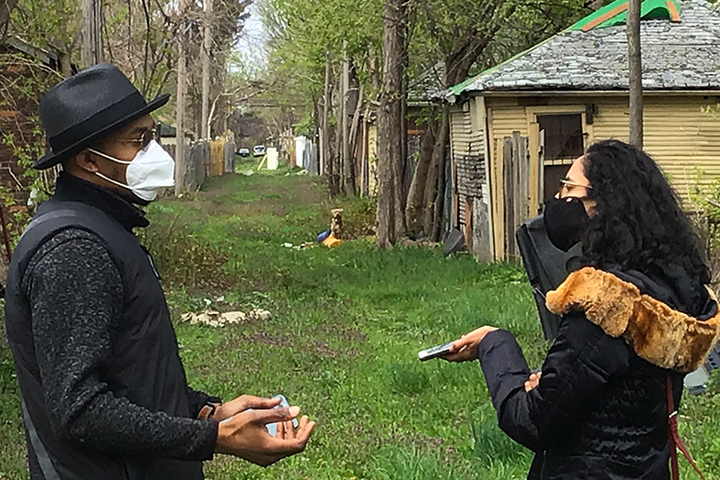
Photo credit: Paul Draus
Project Summary
In 2020, Detroit began clearing long-neglected alleys, once used for trash pickup and utilities but decommissioned decades ago, and invited neighborhood block clubs to take on future maintenance. Building on earlier collaborations with Detroit residents, this project explored how reopened alleys could support placemaking and sustainability goals rooted in local history and aligned with current neighborhood needs.
The team and partners transformed several neglected alleys into small-scale demonstration sites, offering proof of concept for sustainability solutions at the neighborhood scale. Building on a previous Catalyst Grant project, the team worked with residents to create a working model alley that generates renewable energy and helps manage rainwater.
Using recycled materials, the team built a small wind and solar power system to run lights and a cooling mister. Additional features include an interactive flood-risk map based on field surveys, rain barrels, and pollinator gardens. Hands-on workshops built community knowledge and support, while interviews with residents informed the design process. Community members also co-created a public showcase event and contributed to virtual reality (VR) alley designs.
The team’s emphasis on community-driven planning and visible, replicable technologies positioned the alley not only as an environmental asset but as a gathering space with potential for entrepreneurship, recreation, and long-term neighborhood resilience.
This pilot demonstrated how low-cost, context-sensitive solutions can promote equitable sustainability at the local scale. It strengthened partnerships between researchers and community-based organizations in Detroit, laying the groundwork for continued collaboration. Additional funding, including a $50,000 Thriving Cities Challenge award and a $39,960 Dearborn-Flint Collaborative Research Grant, is supporting ongoing model development for use in other Detroit neighborhoods and potentially in other cities. By grounding technical interventions in community priorities, the project provides a foundation for scalable approaches that deliver environmental, social, and economic benefits, led by and for the neighborhoods they serve.
In the Media
- Dearborn professor works in partnership to reinvigorate Detroit | The University Record
- UM-Dearborn working with neighborhoods to fix blighted alleys | Press & Guide
- Community brings a fresh spin to Detroit alleyways | University of Michigan News
- Canfield Consortium awarded $50,000 to ‘activate’ a previously abandoned alleyway on Detroit’s east side | Planet Detroit
Tools & Resources
- Detroit Alley Activation Interactive Map
- The map shows where stormwater can be captured by mapping garage conditions, downspouts, and alley surfaces. Using Light Detection and Ranging (LiDAR) and field surveys, it also highlights flood-prone areas and their potential for rainwater reuse. Ultimately, it helps residents and planners to identify opportunities for green infrastructure, such as rain barrels and gardens.
This Project Received a $9,966 Catalyst Grant in 2021.
Project team: Paul Draus, PI (Sociology | U-M Dearborn); Christopher Pannier (Mechanical Engineering | U-M Dearborn); Jacob Napieralski (Geology | U-M Dearborn); Korey Batey (DAVIS (Detroit Ain't Violent It's Safe)); Carlos Nielbock (CAN Art Handworks); Charles Rivers (The Neighborhood Association).