Improved Understanding of Sediment Dynamics for the South Slough NERR and the Greater Coos Bay Estuary
Improved Understanding of Sediment Dynamics for the South Slough NERR and the Greater Coos Bay Estuary
Improved Understanding of Sediment Dynamics for the South Slough NERR and the Greater Coos Bay Estuary
Program: NERRS Science Collaborative
Program details » | All NERRS Science Collaborative projects »
Why this work?
The Coos Bay estuary in Oregon has a diverse set of end users who share a common need: to better understand circulation and sediment transport under current and future conditions. The estuary is one of three Oregon estuaries designated as “deep draft development,” which means that planners must balance industry, restoration, and natural resource goals. The project team’s primary research objectives are to fill data gaps that are critical to addressing their myriad management needs. These needs include characterizing the present-day sediment distribution, monitoring sediment fluxes to the estuary, and modeling how circulation and sediment in the estuary will respond to perturbations due to both natural and human-induced causes—such as dredging or inundation caused by sea level rise.
About this project
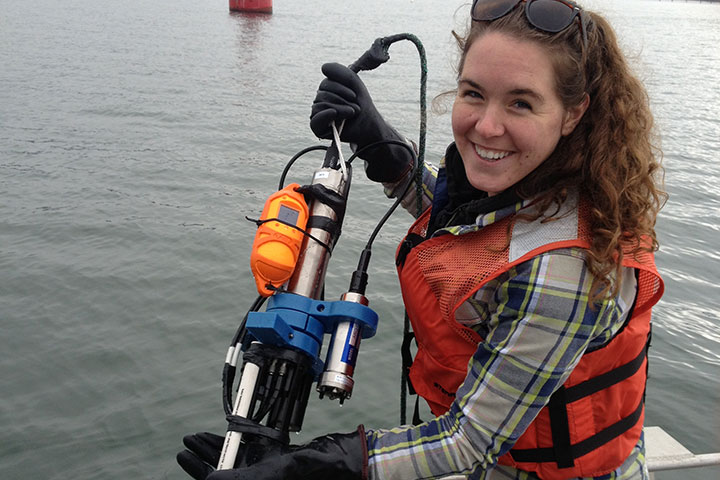
The project will combine new observations and model development. Observations, which include bathymetry, water properties (temperature and salinity), velocity, sediment type, and sediment concentration, will be combined with existing time series and maps. The project team will also develop a hydrodynamic model that can skillfully reproduce the observed velocities and water properties in the estuary over a range of forcing conditions (e.g., river discharge, winds, tides). The hydrodynamic model will incorporate a sediment dynamics component, which will be tested against observations. End users will remain engaged throughout the project to reach agreed-upon outcomes, such as updating the estuarine management plan, improving the success of oyster restoration projects, informing fisheries habitat maps, and increasing data efficiency among community stakeholders.
Project lead and contact
David Sutherland, University of Oregon, Email: [email protected]
To learn more, view the project factsheet (PDF).